
New perspectives, noteworthy discoveries, and the design details worth taking in.
There's something particularly inspiring about walking into a showroom and discovering something you didn't know you were looking for.
Twice a year, High Point Market brings together the worlds largest collection of manufacturers, artisans, and design professionals. It's where new collections make their debut, familiar materials are reimagined, and conversations about the future of design take shape.
Market is an opportunity to see what's trending and for us, it's also an opportunity to look a little further.
We come looking for craftsmanship that deserves recognition, innovations that solve real design challenges, and materials that offer something beyond their visual appeal. A chance to ask questions about construction, performance, customization, and many other details that aren't always apparent from a showroom floor.
Because while inspiration may begin with something beautiful, knowing how and whether to incorporate it into a home requires an entirely different level of understanding.
What Caught Our Attention
Every Market has its share of standout moments. Some are impossible to miss. Others reveal themselves in the smaller details: an unexpected material combination, a particularly clever construction method, or a manufacturer approaching a familiar product from an entirely new perspective.
This season, a few discoveries earned a closer look.
The age of analog is back-Making Room for Connection
Less screen time. More face time.
Of all the things we encountered at Market, one of the most interesting wasn't a new material, an innovative finish, or a particularly extraordinary piece of craftsmanship.
A game table.
Nearly every showroom we entered featured some interpretation of one: beautifully crafted tables designed for chess, cards, backgammon, mahjong, shuffleboard, or simply gathering around with friends and family.
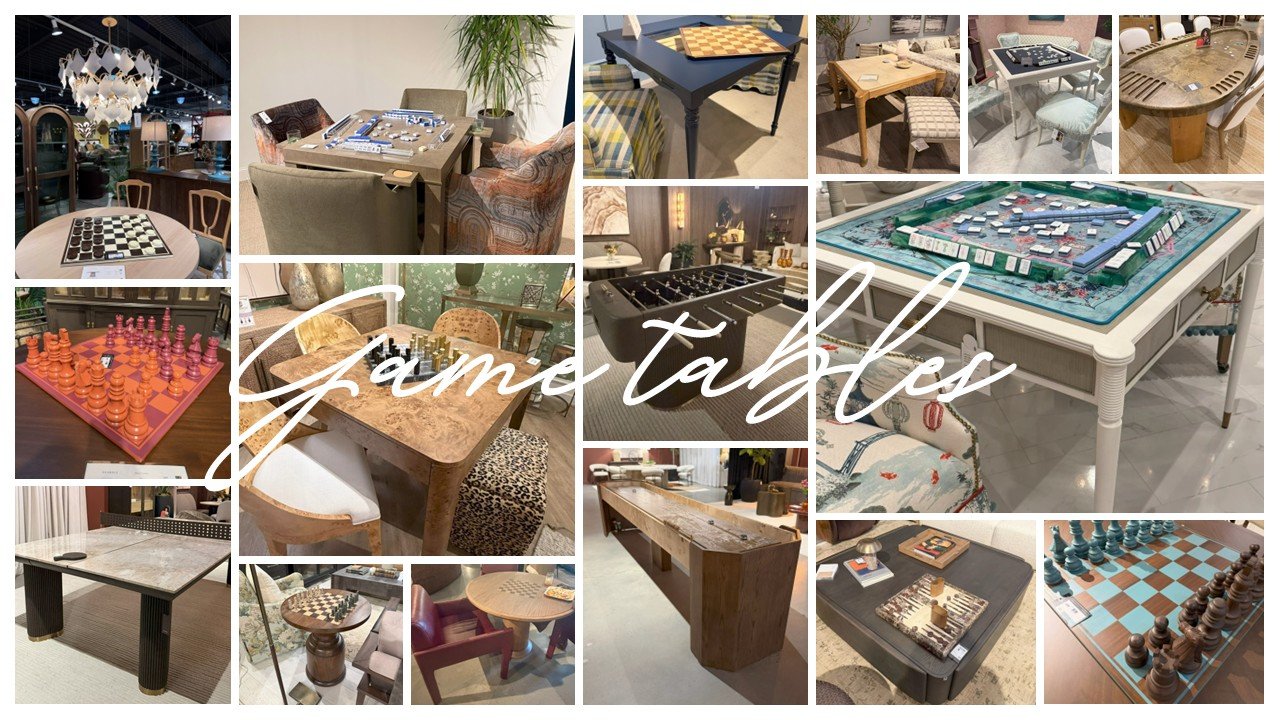
And while game tables are certainly nothing new, their overwhelming presence felt particularly relevant to the way we're living today. We exist in a world where technology is integrated into nearly every part of our daily lives. Our homes are increasingly connected, our devices increasingly sophisticated, and our attention increasingly divided.
Yet in the midst of all this technological advancement, we're seeing an interesting counterpoint emerge: a desire to return to simpler, more tactile experiences. The ritual of gathering around a table. The conversation that unfolds over a game. An evening spent together without a screen competing for everyone's attention.
There's something wonderfully refreshing about that.
From a design perspective, we find this especially compelling because it speaks to a larger conversation about how we plan our homes.
For years, residential design has emphasized open-concept entertaining, expansive kitchens, and media-focused living spaces. And while those spaces absolutely have their place, we're equally interested in creating opportunities for smaller, more intimate interactions.
A game table tucked into a library. A dedicated space for cards just off the living room. A beautifully appointed lounge designed for conversation rather than television. These aren't simply decorative additions. They're opportunities to encourage a different way of living.
Our takeaway: The most meaningful luxury may not be another technological convenience, but the ability to disconnect from it. We're particularly interested in how thoughtfully designed spaces can create more opportunities for authentic human connection.
Beyond the basics-The Finishing Touch, Refined
A little embellishment goes a long way.
If the game tables spoke to how we want to spend our time, the next trend spoke to how we want our homes to feel.
Across Market, decorative trims were having a moment and not in a particularly subtle way.
We saw pleated and ruffled skirts, brush fringe, tailored leather welts, tassels, bullion fringe, and beautifully embellished upholstery weaved throughout each showroom.
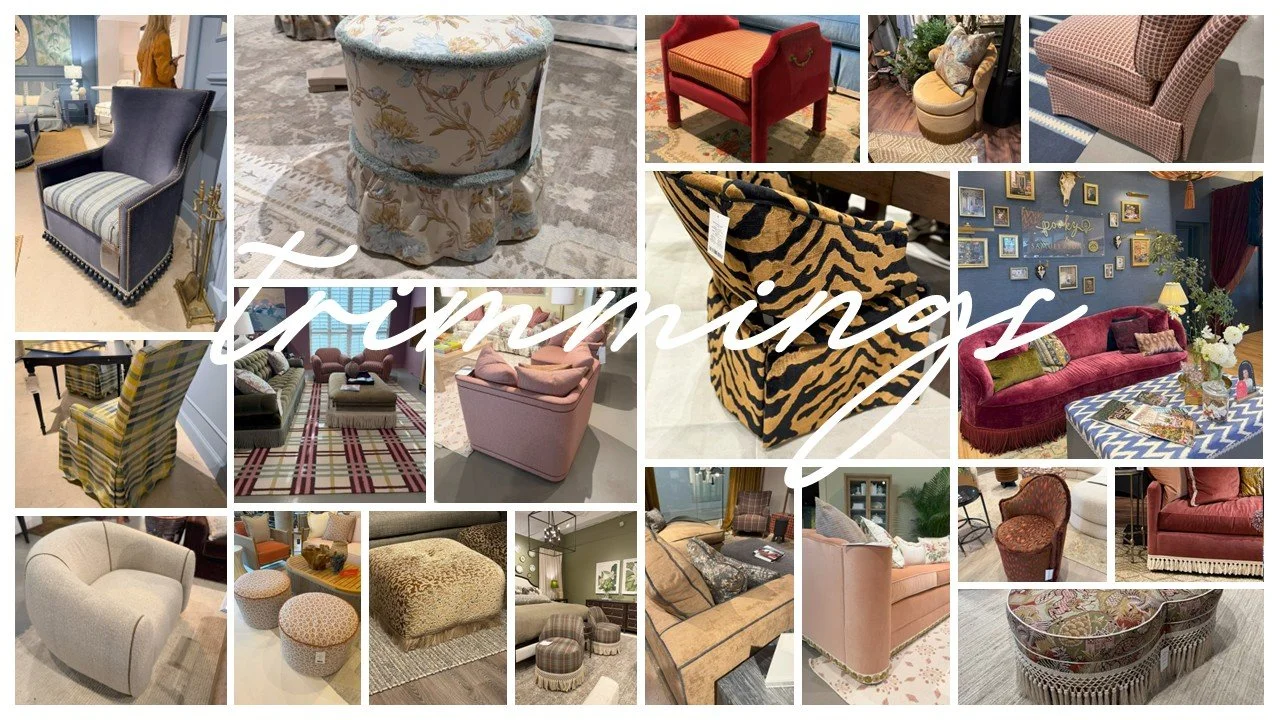
Details that, not so long ago, might have been dismissed as overly traditional are finding their way back into contemporary interiors--and we're here for it!
What's particularly interesting is the way these elements are being interpreted. Rather than recreating traditional interiors exactly as they once were, manufacturers are introducing familiar decorative techniques through fresh proportions, unexpected material combinations, and more contemporary applications.
A tailored pleated skirt can soften an otherwise architectural piece. A leather welt can bring definition to upholstery. A fringe detail can introduce movement and a sense of playfulness to an otherwise restrained composition.
These are the kinds of details that make furnishings feel less mass-produced and more individual.
They're also a reminder of the importance of craftsmanship & the idea of sourcing smarter, and for longevity rather than the mass produced landfill pieces that are at our fingertips everyday.
Decorative trimming requires a level of precision and execution that is easy to overlook. The quality of the stitching, the scale of the embellishment, and the relationship between the trim and the upholstery all influence the finished result.
Our takeaway: We see the renewed interest in decorative trims as an opportunity to introduce personality, texture, and craftsmanship into a home. The key is knowing where these details will contribute something meaningful and where restraint better serves the overall design.
Color Has Entered the Conversation, and It's here to Stay.
The case for interiors with a little more personality. If you’ve worked with our studio, you know we love to push our clients slightly outside of their comfort zone with the use of color. We know that these often return the best rooms when they trust our discretion.
For anyone wondering whether the return of color was simply a passing trend, this season's Market offered a fairly convincing answer. Color was everywhere.
From rich olive greens and vibrant chartreuse to deep russet, earthy salmon, and moody shades of blue, a compelling spectrum of color emerged as a recurring theme throughout the showrooms.
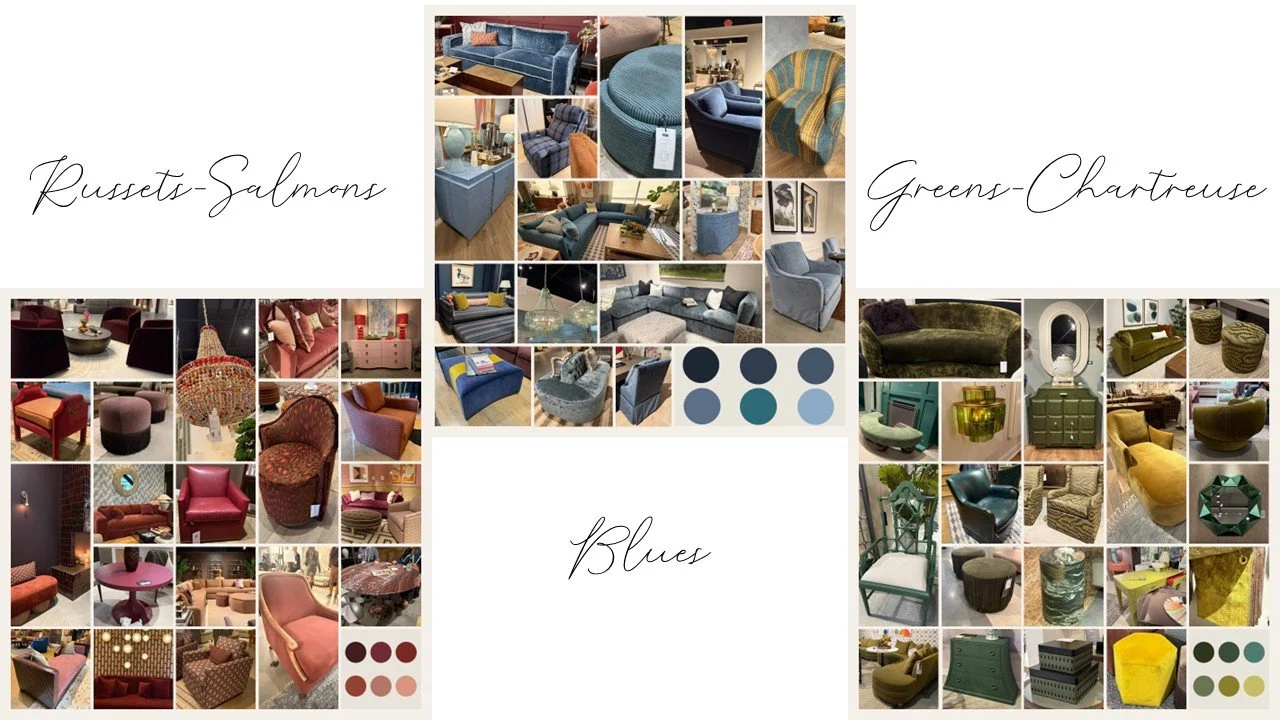
And it wasn't necessarily confined to a single accent piece. We saw an ongoing embrace of layered palettes, richer combinations of materials, and vignettes that felt increasingly comfortable mixing patterns, textures, and decorative influences.
Perhaps the beauty of design lies in its subjectivity. Creativity is interpreted differently through every lens, allowing for a certain freedom of expression where the same piece can take on an entirely new identity depending on its surroundings. Traditional influences are being reimagined, patterns are layered with confidence, and colors are brought together in unexpected combinations. The result is a refreshing departure from formulaic interiors in favor of spaces rich in visual depth, character, and individuality, where the rules are less rigid and the possibilities far more interesting.
In many ways, this aligns with the broader return of traditional maximalism—though we think the term deserves a little nuance. Maximalism doesn't necessarily mean filling every available surface or abandoning restraint. At its best, it's about creating richness through the relationship between color, pattern, form, and material.
A room can be layered without feeling chaotic. It can be colorful without feeling trendy. And it can embrace traditional detailing while still feeling entirely appropriate for a contemporary home.
For our studio, the most exciting part of this movement isn't any particular color palette. It's the growing acceptance that interiors don't need to subscribe to one universally popular aesthetic.
We have always believed that a home should reflect the people who live there, rather than a signature style tied to the designer themselves.
Our takeaway: Color is not a requirement for good design, nor is a neutral palette inherently lacking in character. The opportunity lies in developing a palette that reflects the client, supports the architecture, and creates a cohesive experience throughout the home.
The Bigger Story, Getting Back to Homes With Character
At first glance, game tables, decorative trims, and colorful interiors might not seem to have much in common.
But after spending time moving between showrooms, we couldn't help noticing the connection.
Each represents, in its own way, a shift toward interiors that feel less prescribed and more expressive.
Game tables encourage real human interaction. Decorative details celebrate craftsmanship and individuality. Color invites us to move beyond the safety of universally accepted palettes and create spaces with greater personality.
Together, they suggest a renewed appreciation for the human experience within the home.
And that's a direction we can get behind.
Of course, observing a trend and incorporating it successfully are two very different things.
Just because a particular piece makes an appearance in dozens of showrooms doesn't mean it belongs in your home. A richly embellished sofa may be extraordinary in one setting and entirely out of place in another. For us, the excitement lies in exploring the possibilities, imagining how a familiar piece might take on an entirely new character in an upcoming project, discovering unexpected applications, and ultimately selecting the elements that contribute something meaningful to the story we're helping our clients tell.
What We're Bringing Home
The most valuable things we bring back from Market rarely fit in a suitcase. They're the conversations with our trusted manufacturers, the knowledge gained through testing products firsthand, and the relationships strengthened along the way.
This season, we returned with a renewed appreciation for the role our homes play in bringing people together and the importance of creating spaces that reflect more than a passing aesthetic. While there will always be the next viral trend, the most successful homes are the ones that tell the story that remains relevant long after those trends have passed.
And those stories begin with the people who live there.
Your home is more than a place to live. It's where your story unfolds.